
Basic Models and Why Loading Matters
Prepaid debit cards for travel are loaded instruments that permit spending up to the amount stored on the card. The class includes single-currency travel cards, multi-currency prepaid cards and modern fintech wallets that issue Visa or Mastercard-branded physical and virtual cards. For users who travel often or accept payments in multiple currencies, the process of how to top up prepaid card balances changes the effective price paid for purchases and cash withdrawals. An issuer’s exchange policy and reload fees are the two factors that most often dwarf nominal card issuance charges when total trip costs are modelled. https://wise.com, https://www.revolut.com
Primary Reload Methods: Mechanics and Tradeoffs
Most reloadable international prepaid card products support a subset of the following top-up channels. Each method has different cost, speed and risk characteristics.
- Bank transfer (ACH/SEPA/SWIFT). Usually the lowest direct cost, but slower on cross-border transfers. Bank transfers are the recommended method to minimise transactional top-up fees before travel; they often convert at an issuer or network rate after receipt. https://www.payoneer.com
- Debit card top-up. Immediate in most apps; may incur an acquiring or processing fee. Convenient for last-minute needs but sometimes billed as a card-processing percentage.
- Credit card top-up. Immediate but may count as a cash advance from the card issuer, producing interest and fees. Not recommended unless the fee profile is explicit and acceptable.
- Agent or cash reload. Offered by some travel bureaus and supermarkets; convenient but frequently more expensive because of agent commissions.
- Direct receipt / pay-out (for payees). For businesses and freelancers, platforms such as Payoneer provide local receiving accounts that can be converted and loaded; this route is operationally efficient for cross-border payees but has its own withdrawal and conversion schedule. Payoneer’s published schedule is an example of the flat-plus-percentage approach seen in many providers. https://www.payoneer.com
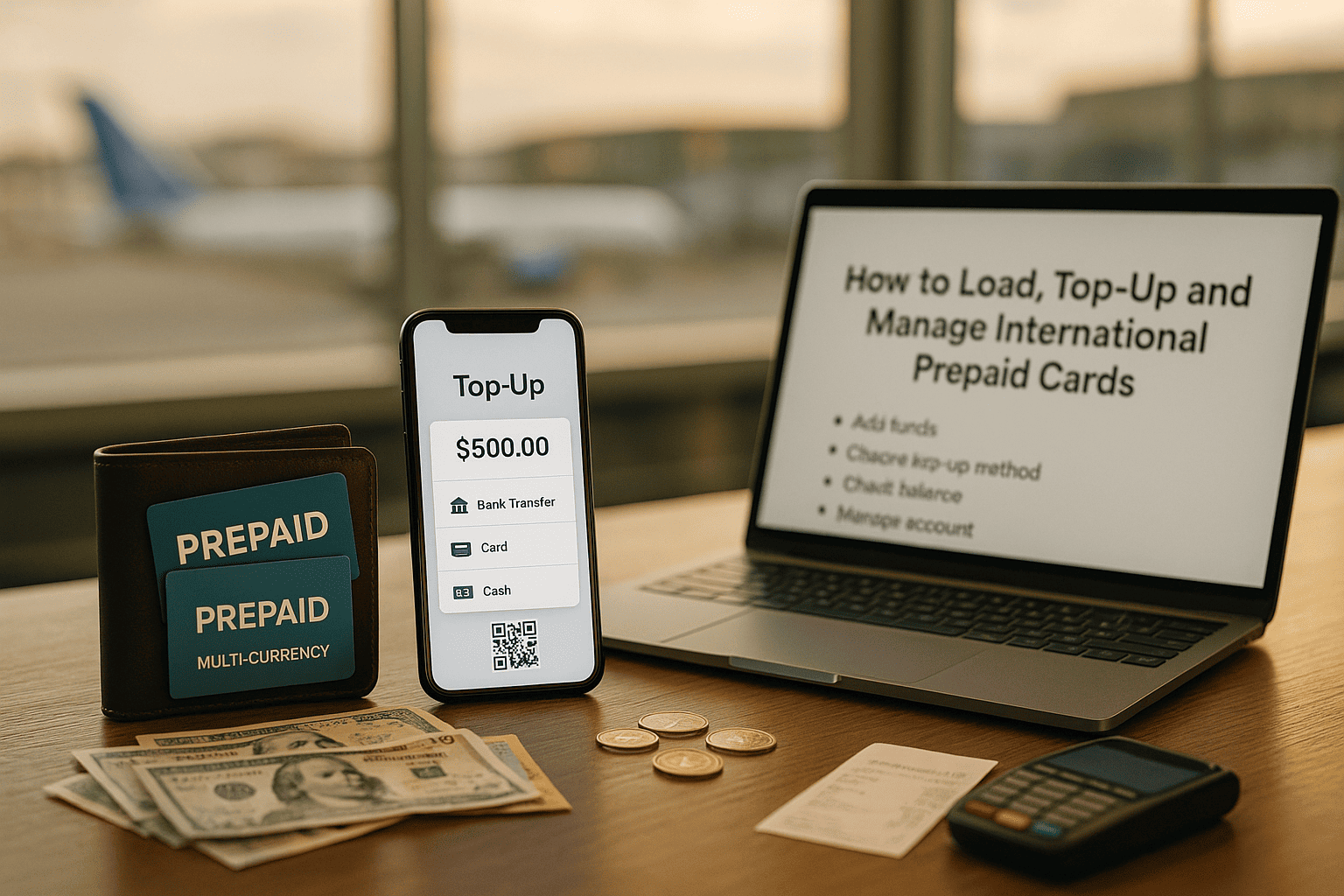
A practical user decision matrix weights speed (how soon funds are available), certainty (exact converted amount), and cost (flat or percentage fees). For substantial pre-travel conversions, bank transfer is the default low-cost route; for last-minute top-ups, debit card loads trade cost for immediacy.
Understanding Exchange Treatment at Top-Up and Spend
Two stages can apply an FX event: at top-up (preloading the destination currency) or at spend (real-time conversion by the network or issuer). The economic difference matters.
- Top-up in destination currency. The user converts in the issuer app at the moment of top-up and locks the exchange rate for subsequent local spending. This eliminates on-terminal FX spread for that balance and is one reason multi-currency prepaid cards are appealing for segmented travel budgets. Wise sums this approach in its marketing: “We only use the mid-market rate — the one you can check on Google.” That statement is central where the issuer genuinely passes the mid-market rate at conversion. https://wise.com
- Top-up in home currency + conversion at spend. The issuer or the card network converts at transaction time. Networks such as Visa publish daily settlement rates—“Visa provides daily FX rates for the 180+ global currencies that are used within VisaNet to authorize and settle transactions”—and issuers may add a margin on top of the network rate. The practical implication: small per-transaction spreads compound across repeated purchases. https://www.visa.com
A controlled experiment—top up €100 in the issuer app, then pay a €20 purchase—permits reconciliation of claimed and observed rates and reveals whether the issuer applied the mid-market rate or a markup at conversion.
Fees at Top-Up: What to Expect
Reloadable international prepaid card products frequently disclose a menu of potential fees:
- Flat top-up fee. Rare for bank transfers but not uncommon for card or cash loads.
- Percentage processing fee. Common on debit/credit card loads; can range from 1% to 3% or more depending on provider and card network.
- FX conversion fee at top-up. If conversion occurs during top-up, either an explicit fee or an implicit spread (difference between mid-market and applied rate) will appear. Providers that pass the mid-market rate will often still charge a conversion fee for smaller currency pairs or weekends. Wise’s documentation clarifies mid-market usage, but users should verify weekend rules and low-value conversion exceptions. https://wise.com
Always inspect the provider’s pricing or help pages before loading large sums; published tables permit straightforward arithmetic modelling of total load cost.
Cash Withdrawals: ATM Mechanics and Cost Layers
Prepaid card ATM fees are a two-actor problem: the issuer and the ATM owner.
- Issuer charge. Many plans provide a defined free withdrawal allowance (for example, plan thresholds or monthly caps) and charge a flat fee or percentage beyond that allowance. Revolut’s publicly stated rule is an exemplar: “A 2% or 1 € fair usage fee applies thereafter,” with plan-dependent free limits; note that issuer fees are separate from terminal surcharges and should be modelled together. https://www.revolut.com
- Terminal surcharge. The ATM operator may present a surcharge on screen; this fee is often unavoidable and appears in addition to issuer charges. The combined effect is the relevant marginal cash cost. Payoneer’s flat-plus-percentage withdrawal schedule provides a useful worked example that many independent users replicate when modelling ATM costs. https://www.payoneer.com
Practical control: when the ATM displays a surcharge, cancel and try another terminal; compare the issuer’s in-app transaction feed after any withdrawal to confirm whether an issuer fee was also applied.
Operational Controls and App Features
Modern providers offer app features that materially reduce operational risk and control costs:
- Wallets per currency. Multi-currency prepaid cards permit preloading individual currency wallets to avoid repeated conversions.
- Real-time rate previews. Platforms that show the exact exchange rate before a conversion avoid surprise. Wise and several top fintechs include pre-conversion rate visibility in the UX. https://wise.com
- Lock/unlock, instant freezes. Useful for lost or suspicious activity.
- Top-up limits and scheduled top-ups. Automating regular top-ups avoids last-minute, costly card loads.
- Detailed transaction metadata. Merchant-level descriptors and per-transaction conversion receipts make post-travel reconciliation feasible.
These controls convert the card from a black-box expense to a traceable, auditable instrument.
Testing Protocol: Minimum Three Checks Before Travel
A short testing protocol converts marketing claims into verified economics:
- Small conversion. Top up a modest amount and note the exact rate and any fee. Reconcile against a mid-market feed at the same timestamp. https://wise.com
- POS spend. Make a low-value purchase and confirm the transaction amount in the app feed to test whether the issuer converts at spend.
- ATM withdrawal. Withdraw the minimum note bundle, note any on-screen surcharge, and reconcile in-app and bank statements for issuer fees. https://www.revolut.com, https://www.payoneer.com
Completing these three tests before travel reduces the chance that the card’s fee profile will surprise the user on the road.
Where to Read Comparative Evidence
Independent comparisons of top prepaid travel cards and international prepaid debit cards comparison articles are regularly updated by consumer outlets and financial press. Readers should review the latest lists of best international prepaid debit cards and top prepaid travel cards to match product terms with planned trip behaviour; publications such as Forbes Advisor and Which? publish thorough testing methodologies and periodic updates that are useful starting points.
Final Considerations
A reloadable international prepaid card is a utilitarian tool: it can isolate travel cash, lock favourable exchange rates at top-up, and limit exposure to credit risk. Its relative savings derive from three verifiable factors—the cost of loading funds, the exchange method applied (mid-market vs margin), and the composite ATM cost (issuer fee plus terminal surcharge). The pragmatic buyer converts marketing claims into testable hypotheses using three short experiments (conversion, POS spend, ATM withdrawal) and chooses a top prepaid travel cards candidate by aligning published fees with anticipated behaviour. Regulatory emphasis on disclosure—expressed in European guidance that stresses “promoting transparency, simplicity and fairness in the market for consumer financial products or services across the internal market”—further supports a posture of due diligence before committing significant balances. https://www.visa.com, https://www.forbes.com/advisor/, https://www.which.co.uk