
Who must file an FBAR
The statutory FBAR obligation is simple in form and consequential in effect. FinCEN states: “A United States person that has a financial interest in or signature authority over foreign financial accounts must file an FBAR if the aggregate value of the foreign financial accounts exceeds $10,000 at any time during the calendar year.”
That sentence contains three compliance anchors: (1) the filer must be a U.S. person (citizen, resident, entity), (2) the reported accounts are foreign financial accounts (bank, brokerage, custodial), and (3) the $10,000 aggregate threshold applies at any time during the year. The FBAR is a Treasury filing submitted electronically through the BSA E-Filing System; it is not attached to the tax return. The due date is April 15 for the calendar-year report with an automatic six-month extension to October 15.
FATCA, Form 8938 and threshold comparisons
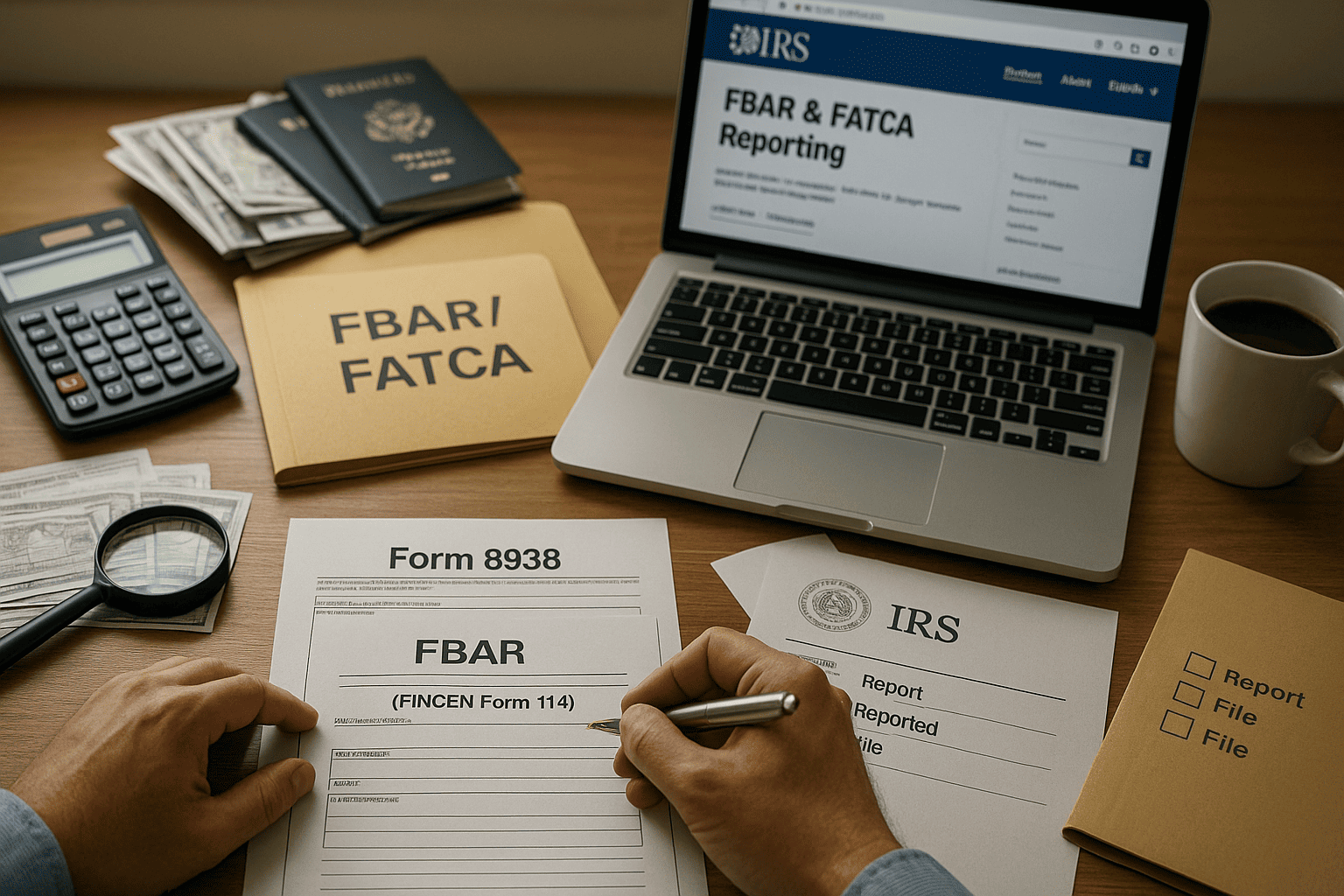
FATCA reporting via IRS Form 8938 uses different thresholds and scope. The IRS summary contrasts the two regimes and lists filing thresholds that depend on filing status and residence. The agency explains the household-level thresholds in plain terms, for example: “Unmarried individual (or married filing separately): Total value of assets was more than $50,000 on the last day of the tax year, or more than $75,000 at any time during the year.” Comparable thresholds double for married filing jointly and move substantially higher for specified individuals living abroad (for example, $200,000 on the last day or $300,000 at any time for some filers).
Form 8938 is filed with the taxpayer’s income-tax return. The IRS cautions that Form 8938 and the FBAR are separate obligations: “The filing of Form 8938 does not relieve you of the separate requirement to file the FBAR if you are otherwise required to do so, and vice-versa.”
Penalties and enforcement posture
Penalties for noncompliance are the most consequential feature of the statutes. The National Taxpayer Advocate’s analysis summarizes the statutory framework: “The amount depends on whether the failure was ‘willful’ or ‘non-willful.’ The maximum penalty for a non-willful violation is $10,000 (adjusted for inflation). The maximum civil penalty for a willful violation is 50 percent of the maximum account balance during the year (or, if greater, $100,000 [adjusted for inflation] per violation).”
Courts and administrative guidance complicate the application of those maximums because fact patterns determine willfulness. The IRS has mitigation and voluntary-compliance pathways that reduce or eliminate penalties for taxpayers who correct errors before the agency contacts them; the Delinquent FBAR Submission Procedures and the Streamlined Filing Compliance Procedures are the two primary routes for taxpayers who missed past filings but were non-willful. The IRS describes the Delinquent FBAR Submission Procedures as a process to file past FBARs electronically and attach an explanatory statement; taxpayers who meet the program conditions typically avoid penalties under that procedure.
FinCEN’s public materials show sustained filing volume and enforcement activity. The agency’s Year in Review reports BSA filing totals and the scale of FBAR-class reporting in recent fiscal years; that reporting volume explains why enforcement resources and automated queries are concentrated on foreign-account reporting.
Common reporting traps
- Treating a local branch of a U.S. bank as a foreign account. An account held at a U.S. branch of a foreign bank is generally not a foreign financial account for Form 8938; confirm the legal situs of the account and the bank’s corporate structure.
- Confusing the FBAR $10,000 threshold with the Form 8938 thresholds. The two are not interchangeable. A U.S. person with an aggregate foreign balance of $12,000 in a single foreign checking account must file an FBAR; Form 8938 will only be required if the filer’s specified foreign financial assets reach the IRS threshold given filing status.
- Neglecting signature-authority reporting. Individuals with only signature authority over an employer’s foreign account may need to report that authority on an FBAR even though they have no beneficial interest.
Practical compliance steps
- Inventory every foreign financial relationship. Include bank accounts, custodial accounts, securities held at foreign brokers, foreign pensions and certain insurance contracts that qualify as specified foreign financial assets for Form 8938.
- Calculate yearly maximums for FBAR purposes and the relevant day-by-day values for Form 8938 thresholds. The FBAR uses the aggregate maximum value at any time during the year. Form 8938 uses the value rules in its instructions.
- File FBARs electronically through FinCEN’s BSA E-Filing System by April 15 with the automatic extension to October 15 if necessary. If a filer missed earlier years and meets the non-willful criteria, use the Delinquent FBAR Submission Procedures.
- Attach Form 8938 to the taxpayer’s annual return when thresholds are exceeded. Reconcile lines on Form 8938 with other reporting forms such as Forms 3520, 5471 or 8621 when relevant.
- If uncertainty exists about willfulness or unreported income, seek professional representation and consider voluntary compliance options; the Streamlined Filing Compliance Procedures can limit penalties for eligible taxpayers who certify non-willful conduct.
How reporting rules affect foreign-bank and fintech accounts
Individuals and businesses who open a foreign currency account USA or a multi-currency account USA must treat account balances as potential FBAR and Form 8938 assets. Whether the account is a reloadable foreign currency account provided by a fintech, a US foreign currency account at a U.S. branch, or a foreign bank deposit, the legal status changes the reporting calculus but not the requirement to disclose once the thresholds are met. Fintech customers should confirm the custodian arrangements and retain statements that show daily balances; regulators and the IRS use contemporaneous statements when reviewing cases. Where a business foreign currency account USA exists for operating activity, corporate-level information returns and consolidated reporting rules can apply.
Enforcement trends and what the numbers show
FinCEN’s public materials and IRS enforcement reports indicate sustained attention on foreign-account reporting. The FinCEN Year in Review for FY 2023 documents volumes of BSA reporting and how the agency uses that information to support law enforcement and national-security partners. The National Taxpayer Advocate and court decisions have shaped how agencies apply statutory penalty limits, but the result for taxpayers remains the same: failure to file when required creates exposure to severe civil penalties and, in extreme cases, criminal prosecution.
Final Considerations
For U.S. persons holding foreign accounts — from a foreign currency checking account USA to a business foreign currency account USA — the practical priority is accurate inventory, disciplined valuation and timely filing. Start by mapping where accounts sit, confirm whether the account is foreign for FBAR and Form 8938 purposes, and then apply the statutory thresholds to determine filing obligations. If filings are late, use the IRS-delivered compliance pathways such as the Delinquent FBAR Submission Procedures and the Streamlined Filing Compliance Procedures when eligible. Maintain records that document daily or month-end balances, custodial arrangements for reloadable foreign currency account holdings and correspondence that supports reasonable-cause explanations. The tangible cost of compliance is modest relative to the statutory penalties for willful failures; the data and primary-source guidance cited here should be the baseline reference for any person or entity assessing U.S. foreign-account reporting obligations.
Selected sources and primary references: FinCEN — Report Foreign Bank and Financial Accounts (FBAR); FinCEN — Year in Review (FY2023); IRS — Comparison of Form 8938 and FBAR requirements; National Taxpayer Advocate — Purple Book (excerpt on FBAR penalties); IRS — Delinquent FBAR Submission Procedures; IRS — Streamlined Filing Compliance Procedures; BSA E-Filing — File FBAR (FinCEN Form 114).