
What Multi-Currency Prepaid Cards Are, Mechanically
Multi-currency prepaid cards let a user hold balances in several fiat currencies on a single instrument and spend from the loaded balance through Visa or Mastercard rails. They are prepaid: the card authorises transactions up to the stored amount and does not create a credit obligation. For travellers and remote workers, that isolation of travel funds can be useful when budgeting and managing FX exposure.
A decisive technical point concerns exchange sourcing. Some issuers execute conversions at the interbank or mid-market rate; others apply network or provider markups. As one provider states plainly: “We only use the mid-market rate — the one you can check on Google.” That distinction is the core driver of the real cost of using a reloadable international prepaid card.
How Costs Accrue: Fee Types To Watch
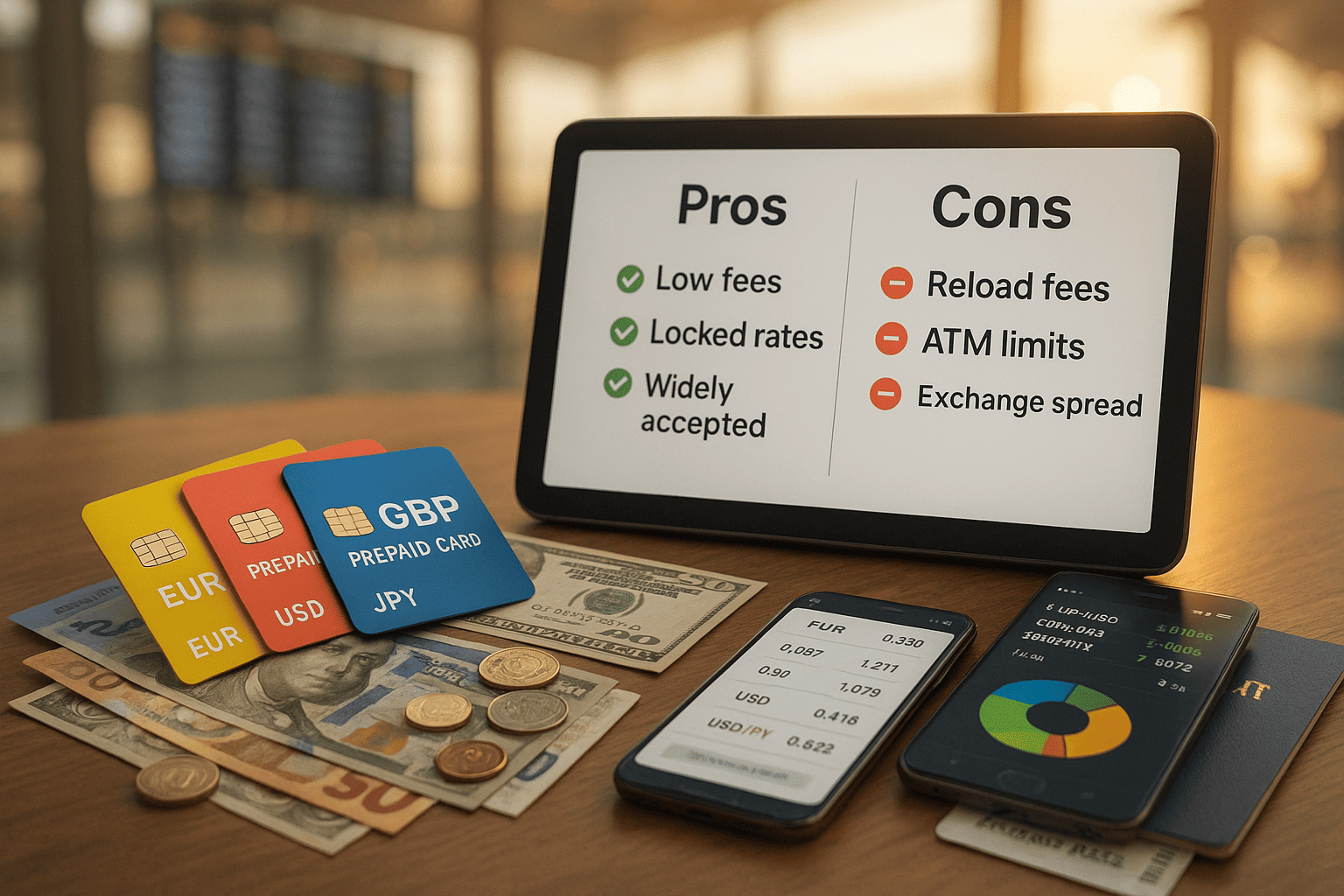
Prepaid debit cards for travel typically layer several fee types:
- Card issuance and shipping fee (one-off).
- Reload fees (percentage or flat fee on top-ups).
- Conversion margin embedded in prepaid card exchange rates or explicit FX fees.
- Prepaid card ATM fees when withdrawing cash (issuer fee + operator surcharge).
- Dormancy or inactivity fees when cards sit unused.
A concrete example: a widely used cross-border payout provider documents ATM withdrawal charges as “Cash withdrawals (ATM, teller, merchant) in the same currency as your card, 3.15 USD / 2.50 EUR / 1.95 GBP + UP TO 1.8% ; Cash withdrawals (ATM, teller, merchant) involving currency conversion 3.15 USD / 2.50 EUR / 1.95 GBP + UP TO 3.5%.” That format—flat amount plus percentage—reappears in many issuer schedules.
Network and issuer ATM rules also matter. One issuer notes: “If you exceed your no-fee withdrawal limit, you’ll be charged 2% of the withdrawal amount or a 1 € fee (whichever is greater) for each withdrawal in the rolling …” with defined free-withdrawal thresholds by plan. Such thresholds transform low-frequency cash use into a predictable marginal cost that must be modelled against alternative cards.
Exchange Rates: Mid-Market vs Markup
Three practical exchange models appear in international prepaid debit cards comparisons:
- Mid-market execution — the issuer converts at near-interbank rates, sometimes charging a separate flat fee. Wise’s published position—“We only use the mid-market rate — the one you can check on Google.”—is the most explicit articulation of this model.
- Network conversion with provider margin — the card networks provide the base rate and the issuer adds a percentage. The net rate is usually worse than mid-market.
- Flat provider markup — the issuer sets an explicit spread on top of the network rate.
For a rational decision, compare the advertised exchange approach and run a sample transaction before committing large balances; small percentage differences compound on repeated spending.
Operational Strengths of Multi-Currency Cards
- Currency control. Users can lock an exchange rate ahead of travel by topping up the relevant wallet. This removes volatility risk for the amount loaded.
- Budget segmentation. Funds allocated to travel remain separated from primary banking accounts.
- Simple foreign spending. When funded with the destination currency, point-of-sale transactions avoid conversion steps and hidden markups.
- App controls. Good issuers provide real-time notifications, card freezes and visible conversion receipts, enabling prompt dispute or sanity checks.
Independent consumer outlets that compare top prepaid travel cards often emphasise these operational benefits while also warning that advantages depend on fee structure and usage intensity.
Material Weaknesses and Behavioral Risks
- Inactivity fees and small leakages. Many traditional travel cards impose dormancy charges; these erode small balances held for long intervals. Consumer reporting demonstrates that inactivity fees can be a material erosion mechanism if not monitored.
- ATM cost layering. Issuer-level free withdrawals are limited and ATM operators frequently add surcharges. Some issuers note that the issuer may not charge ATM fees but “some operators may do so.” Users must treat issuer claims of “no ATM fee” with the caveat that the terminal owner can still add a separate charge.
- Booking holds and vendor acceptance. Hotels and car-rental firms commonly prefer debit or credit cards for authorisation holds. Prepaid travel debit cards may be declined where conditional holds are required.
- Weekend or off-market markups. Some providers add margin for conversions outside standard FX market hours; this detail can be buried in fine print and raise cost for weekend conversions.
Practical Comparison Approach
A defensible international prepaid debit cards comparison proceeds with three tests the user can run in advance:
- Small live transaction. Load €50 (or the local equivalent) and make one card purchase and one ATM withdrawal in the intended currency. Compare the applied rate and the terminal receipt against the mid-market price at the same moment.
- Reload test. Top up via both bank transfer and debit/credit card if possible. Record any processing fee differences and the back-office time until funds appear.
- Dormancy simulation. Read the issuer’s inactivity policy and model the cost of leaving a small balance dormant for 12 months. Some issuers apply monthly deductions that accumulate rapidly.
Use published fee tables and independent reviews—Forbes and Which? maintain periodic comparisons of top prepaid travel cards and disclose methodology for rate and fee testing.
Use Cases That Fit Best
Short trips with predictable cash needs. Preload the target currency to avoid repeated conversion fees.
Frequent multi-country travellers. Multi-currency prepaid cards remove repeated conversion friction when the issuer supports the relevant currency set.
Budget-constrained travellers. The prepaid model prevents accidental overspend and avoids credit risk.
Contrasting cases where another product is superior:
- Frequent hotel/car hires requiring large authorisation holds — prefer travel credit cards for their broader acceptance.
- High ATM dependence with unpredictable terminals — bank debit cards with reimbursed ATM fees or credit cards with no foreign transaction fees may produce lower total cost.
Regulation and Transparency
Regulatory bodies have emphasised the need for clarity. The European Banking Authority states a policy objective of “promoting transparency, simplicity and fairness in the market for consumer financial products or services across the internal market.” That mandate underscores the investor and consumer duty to require visible fee tables and plain-language examples before opening a reloadable international prepaid card.
Actionable Checklist Before Selecting a Card
- Confirm the issuer’s exchange source (mid-market, network, provider markup).
- Test prepaid card ATM fees with a live withdrawal and record terminal surcharges.
- Compare reload methods and their costs; bank transfers are usually cheaper.
- Verify dormancy policies and card-expiry handling for remaining balances.
- Maintain a backup payment method for holds and emergency access.
Where Independent Reviews Place Products
Regular lists of top prepaid travel cards identify products that balance low FX cost and robust app controls. These top prepaid travel cards often include solutions that prioritise mid-market exchange and transparent per-transaction fees, while legacy travel cards sometimes lag on exchange competitiveness. Readers should consult recent comparison articles because product terms change frequently.
Final Considerations
The comparative choice between prepaid travel debit cards, debit alternatives and travel credit cards must be driven by the user’s transaction profile. Multi-currency prepaid cards reduce FX opacity when the issuer uses mid-market execution; they also provide practical budgeting controls. At the same time, prepaid debit cards for travel introduce operational complexities—ATM layering, dormancy charges and merchant acceptance limits—that must be modelled against actual trip behaviour. A prudent approach: run a small live transaction, compare the applied exchange rate to public mid-market quotations, and read the issuer’s fee table for reloads and inactivity. Those simple empirical checks convert marketing claims into verifiable economics and reduce the risk that convenience becomes an avoidable cost.
Selected sources and recent comparisons: Wise — pricing and mid-market explanation, Revolut — ATM thresholds and fees, Payoneer — published ATM and conversion fees, Travelex — ATM surcharge disclosure, Forbes Advisor — independent comparisons, Which? — consumer testing and comparisons, Choice — independent testing, European Banking Authority — regulatory guidance.